

Bupe Banda is a Mastercard Foundation Scholars Program Alumni from the University of Cambridge, where she studied Conservation Leadership in 2022–23. She was part of the University’s very first cohort of Mastercard Foundation Scholars.
Two years on from graduating, we catch up with Bupe about how she’s using her training in her new role with the Alliance for Indigenous Peoples and Local Communities for Conservation in Africa, and the conservation initiatives inspiring her in Zambia and beyond.
Can you tell us about your new role?
I joined AICA (the Alliance for Indigenous Peoples and Local Communities for Conservation in Africa) in August this year as the Coordinator.
AICA is a pan-African network that aims to give a voice to indigenous people and local communities in conservation. The aim is to make sure that people whose lives are intertwined with the environment around them are part of policy making and benefit sharing - and that any injustices are brought to light.
I’m the Alliance’s first employee and head of the secretariat, working closely with the chairperson of the board. The job is to bring this new organisation to life, so the work is really varied. It’s a mix of strategy, administration, partnership building, and fundraising.
It’s a mammoth task and expectations are high, but I know I can do it!
What’s been the most rewarding thing you’ve done since graduating?
Alongside my work with AICA, I’m a mentor with the Wildlife Conservation Network. It’s something I was doing before Cambridge and I’ve seen a lot of change in some of the mentees over that time.
I took part in the mentorship programme linked to my master’s course, Conservation Leadership, and was paired with a wonderful mentor, Dilys Roe, who leads the International Institute for Environment and Development’s work on biodiversity and conservation.
I’ve been reflecting on everything I learnt from her and how I can use my experience to help kick start others’ careers.
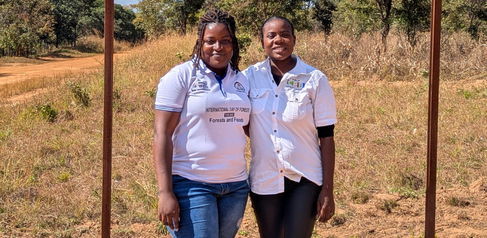
Bupe with mentee, Rachel, at Kashaita Primary School Community-led Conservation Project in Muchinga, Zambia
What are the most exciting initiatives you’re seeing in conservation in Zambia and beyond?
I’m seeing more and more internal collaboration within Africa, which is so important.
The organisation I’m working for now is a good example. AICA was born out of the Africa Protected Areas Congress in 2022 where a major theme of discussion was the lack of internal coordination on conservation issues. Different countries were often working in silos.
There was a declaration at the end of the conference that we should establish a pan-African IPLC (Indigenous peoples and local communities) body to look at what’s happening across the continent and represent our interests at an African level.
Now, seeing some of this being put into action gives me hope that the future of conservation in Africa is really going to be great.
Another example of this came out of the 2023 Southern African 'Heads of State Summit' in Zambia. There, five countries – Zambia plus Angola, Namibia, Zimbabwe and Botswana – worked together to develop a strategy to market tourism in the Kavango Zambezi region to the outside world.
We share a landscape connected by these two rivers so it’s important that we work together. There’s a lot we can learn from each other.
This is something that’s stayed with me from my time in Cambridge. My course gave me the chance to learn from people from different parts of the world. We didn’t always agree, but I learnt a lot from them and I like to think they learnt something from me. It’s changed the way I look at conservation on a global scale.
How important is involving young people in conservation?
Young people aren’t just the future, they are the present.
Involving them now is so important for two reasons. We need to help get them ready to take over. For example, I’ll eventually take responsibility for my father’s farm. To take care of it as well as I can, I need him to tell me how he was doing it.
Secondly, much of the innovation we’re seeing in the world today – whether AI or anything else you can think of – is coming from young minds. We need to create a bridge between traditional knowledge and modern knowledge to come up with the best possible approach to conservation.
So for me, every important discussion should include inter-generational dialogues.
How are young people being prepared for this responsibility?
Young people are being prepared through a mix of formal education, extracurricular initiatives, and intentional inclusion in conservation and policy spaces. But efforts are uneven and need to be better integrated into national systems.
There is clear progress, yet also a gap between pockets of excellence and universal access, especially between rural communities near wildlife areas and urban schools.
At the same time, conservation organisations and networks are increasingly creating platforms, internships, and leadership programmes that position young people as advocates, researchers, and community mobilisers rather than just beneficiaries.
Youth‑focused summits and biodiversity networks are giving young Africans opportunities to contribute directly to regional conservation agendas and policy discussions, ensuring their perspectives shape decisions that affect their futures.
In my new role, one of the activities I will be spearheading is a youth leadership and mentorship initiative, and I am genuinely excited about helping to nurture the next generation of conservation leaders through this work. I am also a proud product of such mentorship programmes myself, which makes this responsibility very personal and meaningful.
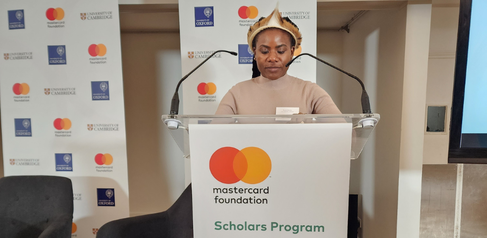
What do you see as your role in all of this?
My role is to help turn all of this potential into reality by creating structured pathways for young people to lead. As AICA Coordinator, I sit at the intersection of Indigenous and local community priorities, conservation networks, and youth voices. This positions me well to design and champion programmes that are truly responsive to young people’s needs.
I’m excited about seeing how this pan-African network can achieve some of the ambitious goals we’ve set ourselves in uniting African communities with one strong voice and seeing some changes in conservation policy. When I say changes, I mean a full cycle – not only has policy been changed, but it’s been implemented too.
But away from my work and being a mentor, I’m also growing a family. I have a two-year old son and a baby girl. I hope in sharing this part of my journey, I can provide encouragement to women in my field to say ‘You can do it. It’s not easy but you don’t have to abandon your career to have a family. The world is slowly embracing us!’.