

As the world grapples with rising temperatures and the challenges a rapidly changing climate poses for human survival, a Mastercard Foundation Scholar at the University of Cambridge has devised a novel way to help keep buildings cool in the heat.
Hauwa Busari, from Nigeria, has been studying for an MPhil in Architecture and Urban Studies at Cambridge over the last year. Her idea is to place panels in the walls to absorb the heat from the sun. These panels contain a naturally occurring substance – algae!
“The algae panel acts as a thermal shade against the sun keeping the building cooler” says Hauwa. “We spend 90% of our lives in buildings and if we don't find a solution to how climate change is impacting us, there’s going to be a big problem and the most vulnerable in society are going to be the most affected.
"I come from a low-income community in Nigeria which means I feel I have a duty to look for a solution to the challenges posed by climate change which can’t be too expensive and out of reach of communities like mine.”
The panels are fitted with transparent tubes filled with spirulina, a blue-green algae which is also now being used as a dietary supplement because of its beneficial nutrient content. Through the natural process of photosynthesis, these panels could cool the interiors of buildings by around 8-10°C without having to resort to air conditioning systems. The algae panels also have the potential to help decarbonise the environment by absorbing CO₂ and filtering the air.
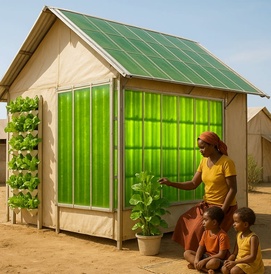
A mock-up image of how the panels would look
“The great thing about this product,” Hauwa adds, “is that it can be fitted in new buildings as well as existing ones. The panels are easy to retrofit. They could also be used in shelters used by people who have been displaced. The problem we have with air-conditioning systems is that they radiate heat so are a net contributor to climate change.”
Earlier in the summer, Hauwa entered her business idea into the Mastercard Foundation Scholars Entrepreneurship Fund Competition. This is held each year to give students the chance to pitch for the top cash prize and further mentoring support.
Hauwa says the last year on the programme has changed her life entirely: “I grew up with nothing and here I am doing something big. I'm really grateful to the prize organisers for believing in my idea.
"It’s all thanks to the Mastercard Foundation. They believed in me, they believed in my idea and now I can dream big. I’m very, very happy."
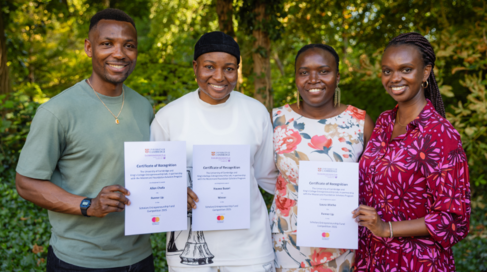
The runners-up in this year’s competition were Allen Chafa, an engineer from Zimbabwe, and Sally Musonye and Laura Wathe, both from Kenya. Sally and Laura, who are on the MPhil Engineering for Sustainable Development course, have a plan for placing solar panels in rural schools across Kenya to help them supply energy to the classrooms. Currently around 65% of people living in rural communities do not have a regular, reliable electricity supply.
Allen, who's also an MPhil student on the same course, is developing smart-water technologies to improve access to safe drinking water in Harare where more than 60% of people lack access to safe piped water. His system combines real-time water quality monitoring with cost-effective purification to address some of the challenges these underserved communities face.