

'Digital literacy opens doors'. It’s the simple mantra behind Tech4Progress – an NGO set up by Mastercard Foundation Scholar Nelson Elijah and friend Favour Oguibe to equip children with essential digital skills.
We speak with Nelson about the moment of realisation that sparked it all, the lessons learned along the way, and what it means to be selected as a recipient of the Fitzwilliam College Charitable Project Award.
What sparked your passion for helping underserved young people navigate the digital world?
I was fortunate to go to one of the best universities in Nigeria, but even so, our curriculum was outdated. This has been evident since coming to Cambridge as I’ve had to play catch up.
I don’t mind doing that, but it bothered me that if I have this problem, then what about others who can’t even dream of such opportunities? Those who are excluded from higher education because they lack access to study resources, or underserved young people who are out of school? How do they not get left behind?
It’s something I was still thinking about when my friend Favour Oguibe, who has a history of catching my attention with powerful questions, came to me and said ‘Nelson, do you know some kids have never turned on a laptop?’.
The question hit hard. I thought about children being left out of the rising digital economy before they reach their teens. I realised that while I couldn’t do much to influence education at the top level right now, at the grassroots level we could make a difference by giving young people a practical grounding and a purpose.
How did you get started?
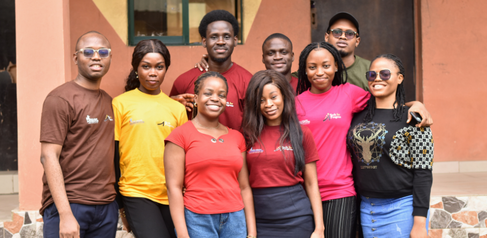
Favour and I prepared fliers with volunteers Ikhide Emmanuel-Solomon, Chijama Chidera, and Fortune Oguibe. We went door to door, informing students and parents of our free digital literacy classes which would run in a local school on Saturday mornings.
We also went to a very popular government school in the community we’d chosen to work in – Isolo, Lagos, and introduced the course as the first of its kind in the area.
We had between 30 and 40 students in the first class! It was surreal for us but made us realise we were onto something. We immediately called for more volunteers as there were just five of us teaching at that point, and there was no way we could give this many students the attention we wanted to.
What was the student’s response to the new classes, and what seemed to work best?
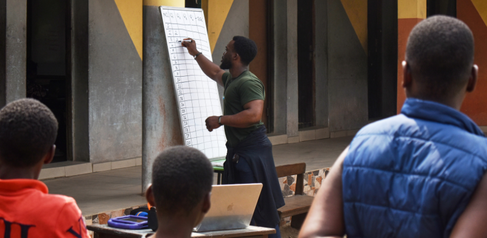
They were excited! We started with an introduction to computers, typing and training in Microsoft Office packages. They loved Word and PowerPoint but had a bit of a challenge with Excel – not surprising!
Students were also interested in design, so we added Canva as it’s easy to use and genuinely useful in lots of different jobs.
We found that the joy from playing around with the computers meant that some were so engaged that when it came to the ‘pop quizzes’ at the end of each session, they’d not only give the right answers but would remember random facts like who invented Microsoft and when!
The timing of the classes worked well. We started the course in February ahead of two important exams – the West African Examinations Council (WAEC) exam which comes at the end of secondary school, and the Joint Admissions and Matriculation Board (JAMB) which is for entry into colleges or universities. These are typically in April or May and mostly computer-based, so helping students prepare for them and going through some practice exams in classes was a real incentive. What happens if someone has the knowledge to pass the test but doesn’t know how to use a computer? It’s going to be a catastrophe.
We rounded off 35 weeks of training with a competition with the top five students winning a laptop. One of the five was a very young girl, she couldn’t be more than 10, who came above some of her seniors who were 15 or 16. That was a real joy for us.

What are the main challenges you’ve faced along the way?
There’s this dilemma we had. The programme was run on Saturdays as that’s when the students and volunteers where available, and we could get a venue.
The problem was that most of the students assisted their parents with some tasks at the weekend, like helping with the family’s kiosk. It was a hard to convince the parents that their kids should come and learn about computers when they would usually be helping the family fend for their daily bread.
We had conversations with parents when we’d say; “the future is digital. People are making money from their phones. You don’t want your children to be left behind”.
Then our job was to teach so passionately that they would go and convince their family, their friends, that this was a worthwhile thing to do. If we weren’t going to be passionate, there was no way they would turn up or help spread the word.
How have you grown personally through launching Tech4Progress?
I’ve been a good student, I’ve read my books and done my coursework. I’m here in Cambridge on this scholarship and I’ve thrived in what’s always been quite a controlled, structured environment.
But in life outside of that environment, there’s no structure. This is something I’m less familiar with. Having no structure makes things much more difficult as something could happen and you have to quickly adapt. That’s the biggest lesson I’ve learnt – how to think on my feet and adapt.
To give an example, in one class I was trying to teach some of the students who were being disruptive. I reprimanded them and asked them to kneel – a common thing in classrooms in Nigeria and something I experienced growing up. They knelt, no problem, but they then stopped coming.
I don’t think it was the fact that I asked them to kneel, more that they went home and told their parents who then wouldn’t let them attend.
Luckily their houses were close by so I went to speak to their parents, telling them that we really liked them, they were active in class and making progress. I apologised and reiterated the benefits of the classes. They came back and I found I could still reprimand students but had more success doing it in a light-hearted, almost jokey way. These were the moments and experiences that made me grow most.
How will your experiences in Cambridge benefit your students?
One of the things that drew me to the Mastercard Foundation Scholars Program in Cambridge was the extracurricular development opportunities you have alongside your course.
I’m learning better leadership methods and hearing about the experiences of other leaders through the training with Cambridge Institute for Sustainability Leadership. During the first module in December I learned a great deal about non-verbal cues which often speak the loudest, and how only merit, honesty, and pragmatism can truly transform us into great leaders.
I’ve also been accepted onto the King’s College E-Lab entrepreneurship course. I’m interested in learning about pitching for funding as we want to expand to other areas and I plan to enter the entrepreneurship competition later this year.
You were recently chosen as one of the recipients of the Fitzwilliam College Charitable Project Award. How will you use the money?
This is where I’ll give a shoutout to Dylan Horn, the Tutorial Officer at Fitzwilliam. He shared the opportunity and I wrote back to ask if Tech4Progress was the kind of project that could be funded and whether we could apply as international students. He was supportive and even reminded me of the upcoming deadline when my application got waylaid by coursework!
We’re planning our next course right now, to start in February. The money from Fitzwilliam will help fund that, including learning materials and snacks and drinks for the kids.
The main change this year is that alongside teaching kids, we’re planning to pilot a ‘Train the trainer’ course.
One of the main questions we’ve been thinking about is ‘how exactly do we ensure the students have some sort of continuity?’. For the seniors who were going to college, we set up a group chat and shared learning resources on the application of technology in whatever field they were interested in. But there’s only so much you can do via group chat, particularly for the younger learners.
We also found that some of the kids’ teachers would come to the weekend classes and ask us to teach them as well. It wasn’t something we really had enough time or volunteers to do. But by developing a curriculum for teachers, as well as passing on what we’ve learnt about how to teach young people about these topics, we hope we can continue the learning.