

What a way to open the Lent Term. The 13th - 15th January was a surreal experience for Mastercard Foundation Scholars who took part in the King's E-Lab Social Ventures Residential. The programme was designed to support students in developing sustainable and ethical projects with a positive social and environmental impact. It was a dream come true for a student like me who nurtures a dream of building ventures that combine impact, viability, and strong ethical foundations in Africa. The programme was run in collaboration with the Cambridge Centre for Social Innovation.
On the first day, we were introduced to the concept of social ventures by Nicole Helwig, the Executive Director of the Cambridge Centre for Social Innovation, and one of the core highlights was that vision and purpose play a critical role in differentiating social ventures from other forms of businesses. Most importantly, social ventures should be people-centred and driven by environmental impact. We also examined different social venture models, and explored the role of storytelling in humanising, validating, and mobilising support for social ventures.
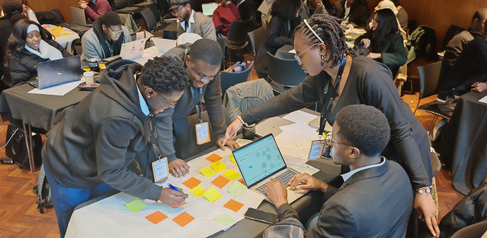
The second day was equally engaging and full of learning moments as we delved into the world of systems mapping as a means of analysing systemic problems. We were grouped and got to engage with one another on how social problems show up at different levels and how this should inform value propositions and operational models. In doing that, we learned that systems mapping helps to connect the dots between the starting point and the leverage points a business can explore.
Photos: Maximilian Ge
The day ended with a fireside chat with the Honourable Minister of Women Affairs and Social Development of the Federal Republic of Nigeria, Hajiya Imaan Sulaiman-Ibrahim, who shared her story and journey to leadership with profound humility. Her speech emphasised that issues such as inequality, poverty, gender exclusion and institutional weakness cannot be solved by individual effort alone. Hence, sustainable social change depends on collaboration between government, communities, innovators, and institutions, not on single actors working in isolation. This infused a sense of renewed purpose into the room as we left with the thought that everyone has a part to play in creating the change we desire to see.
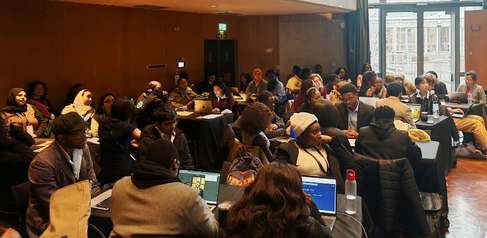
The third and final day lived up to expectations and tied together the conversations we had been having for the past two days neatly. We examined entrepreneurship through the lens of William Baumol, an American economist who argued that entrepreneurship is not always socially beneficial. He explained that where entrepreneurs direct their efforts depends on the incentives and rules set by society. This got the whole room into a debate about exploitative forms of entrepreneurship and their justifications. The highlight of the day was the pitching competition that we had been working on in groups for the past three days, building a social venture that helped solve one of the SDGs assigned.
Photos: Maximilian Ge
My team worked on SDG target 4.1 – free primary and secondary education – and we presented a technology-based data monitoring platform that tracked students' attendance and assessment to indicate students who need support and then pair them up for mentorship. Our model was partnering with government for adoption, giving them access to real-time data of students' progress and performance. What is even more interesting is that we developed a prototype of what it would look like. We also had fun developing confidence and presentation skills through pitching our idea in front of the whole cohort.
The social venture residential was truly a beautiful and transformative experience. One that would go a long way in helping every participant build successful social ventures that would contribute to the progress of the continent.
A huge thank you to the Mastercard Foundation and King's E-Lab for creating this space, and to all the facilitators from Cambridge Centre for Social Innovation who generously shared their knowledge and experience.