
Above: Kaitochukwu at African Development Bank HQ in Abidjan
The Mastercard Foundation Scholars Program’s strong focus on supporting young people to access meaningful work means that support continues well beyond graduation day.
For Mastercard Foundation Scholars seeking to gain relevant experience, strengthen their skills in a supportive environment, or explore whether a sector is the right fit, a placement or internship with an organisation in Africa can provide the ideal bridge from academia to the world of work.
Through our Transitions Project’s Graduate Placement Pathway, we support students to identify and apply for highly relevant 3 to 6-month placements. We also provide financial and professional support to enable them to take up and fully benefit from these opportunities.
We catch up with five of our 2025 graduates whose placements span boardrooms in Abidjan to the plains of the Maasai Mara, to explore how these experiences are building on their academic training and preparing them to make a meaningful impact in their chosen fields.
Kaitochukwu Chukwudi: African Development Bank, Abidjan, Côte d’Ivoire
Kaitochukwu, an Engineering for Sustainable Development graduate, is currently an intern in the Energy Financial Solutions, Policy and Regulations Department of the African Development Bank (AfDB).
“My experience has been a real whirlwind of learning. From a technical perspective, it’s given me valuable exposure to energy finance and a deeper understanding of how financial solutions for energy projects are structured to align public and private sector interests in support of development goals.
My work is largely centred around supporting Mission 300, an initiative led by the African Development Bank, the World Bank, and key partners to connect 300 million Africans to electricity by 2030.
Through stakeholder engagement, contributing to policy briefs, and supporting work on innovative financing mechanisms, I have been able to play a role in pushing this goal forward.
What’s most rewarding for me is seeing how this work connects directly to real people and real outcomes. Knowing that the efforts behind Mission 300 are focused on reaching last-mile communities and ensuring that access to electricity translates into productive use makes the work feel purposeful. It goes beyond infrastructure or policy on paper; it’s about improving livelihoods, enabling opportunities, and supporting long-term, sustainable development. Being part of this process is both motivating and fulfilling."
Diana Amble: Tusome Africa, Buloba, Uganda
Diane, a graduate from Cambridge’s Education, Globalisation, and International Development MPhil programme, joined Tusome Africa as a Research and Programmes Intern.
“Tusome Africa is committed to transforming early childhood education. Its focus on community-led partnerships, evidence-based interventions, and policy influence made this the perfect placement for me.
My mentor and my supervisor, the charity’s founding director, were intentional about supporting my development – involving me in governance, fundraising, communication, programme delivery, and monitoring and evaluation activities. Each of these experiences shaped my understanding of charities and how different functions contribute to overall impact.
One highlight was conducting a needs assessment to support a request to Book Aid International. This was a success, resulting in approval for 3,000 books for the charity’s 13 libraries – an increase from the usual 1,000.
I also participated in regular field visits to the charity’s libraries and Early Childhood Education Centres. These involved monitoring centre activities, collecting historical beneficiary data, and identifying areas for improvement. Following these visits, I prepared detailed field reports outlining key findings, challenges, and school or centre specific recommendations.”
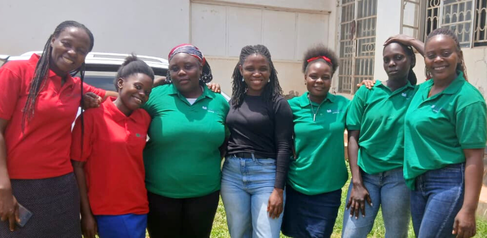
Diana (centre) with teachers from Tusome Africa's Early Childhood Education Centres
Michael Lesecha: Pardamat Conservation Area, Narok, Kenya
Michael, a Tanzanian wildlife conservationist, spent three months in Kenya’s Pardamat Conservation Area (PCA) within the Masaai Mara ecosystem after graduating with a Master’s in Conservation Leadership.
“In Tanzania’s community-managed wildlife areas, one of the main challenges leading to forest loss and environmental degradation is the limited extent to which communities directly experience the benefits of conservation.
The model and lessons I observed at PCA provided valuable insights that could help address this challenge. I intend to apply these lessons in my work upon returning to Tanzania, particularly in designing more inclusive and benefit-driven approaches that encourage both individual and collective commitment to conservation.
Kenya and its people gave me one of the best experiences I have ever had outside my home country. I was fully integrated into the programme and received excellent mentorship, guidance, and support. My colleagues were open, collaborative, and eager to share their knowledge, which greatly enhanced my learning experience.
Given my background and comfort with fieldwork, I found the working environment both enjoyable and fulfilling. In fact, being back in the field surrounded by wildlife and engaging with local communities reminded me how much I had missed this kind of hands-on conservation work.”
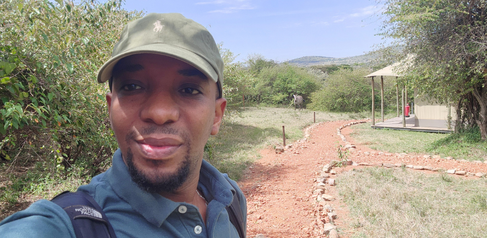
Michael in Kenya's Pardamat Conservation Area
Abraham Zhiri’s placement took him back home to Nigeria
After earning an MPhil in Scientific Computing, Abraham joined a team of mathematical modellers focusing on wildfire preparedness and response in Africa.
“My work bridges theoretical modelling and practical application to address the critical and growing challenge of wildfires, which pose significant threats to ecosystems, biodiversity, and protected natural resources.
Given the complexity and destructive nature of wildfires, there is a strong need for rigorous scientific research to better understand, predict, and ultimately mitigate their impacts.
During my placement, I gained valuable experience of working collaboratively within a team of researchers. Through small-group meetings and structured brainstorming sessions, I learned how to critically engage with diverse perspectives, identify key challenges, and contribute meaningfully to collective problem-solving.
The placement also significantly enhanced my research communication skills. I learned more effective strategies for presenting findings clearly and logically, including structuring results, explaining assumptions and methodologies, and communicating technical concepts to both specialist and non-specialist audiences.”
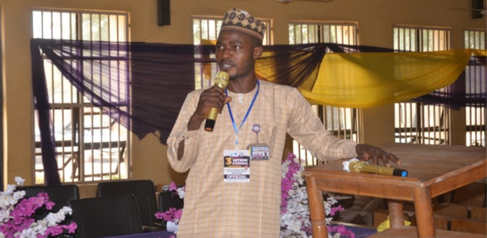
Abraham sharing his research at a mathematics conference
Brenda Mumwesigye: UN Habitat, Nairobi, Kenya
Brenda, an urban planner from Uganda, joined UN Habitat, responsible for promoting sustainable urban development, after completing an MPhil in Planning, Growth and Regeneration.
“I worked on multiple projects which directly aim to solve challenges in society, particularly in Kenya and other developing countries. These included conducting research on how refugees’ conditions can be improved through better governance and undertaking a project on implementing non-motorised transport in Nairobi to reduce congestion and pollution.
I attended a deep-dive learning academy which connected representatives from various countries to find possible solutions for issues facing urban communities. And I was part of the organising committee for the thirteenth World Urban Forum (WUF13) which brought researchers and professionals together to discuss and develop solutions related to housing.
Its diversity made the work environment a great learning space. I had the chance to work alongside colleagues from various disciplines and countries. My supervisor and other team members were supportive, both in helping me understand the general environment and the tasks given.”

Brenda with colleagues at UN Habitat, Nairobi